maanantai 24. syyskuuta 2018

What makes a good landing?

First real autumn weather has hit the Baltics. It is pouring rain all the way to the ground. Yesterday landed in a really gusty wind conditions, which is an integral part of the autumn flying. Wasn't the best landing I've done but the landing gear is still intact and the airplane touched down at the right spot. 

This is the thing: what actually makes a good landing? The passengers seem to judge the pilot by the smoothness of the landing. But the smooth landing is not always the safe landing. For instance, in my case, if I had tried to fine tune the landing by skimming a foot or two above the runway, I would have wasted a lot of runway and perhaps would have missed our turn off intersection (to make the taxi time as short as possible => to get the passengers to the gate as soon as possible).  Moreover, I would have given the wind and the gusts more time to blow our aircraft off the runway centreline. 

Therefore, it is much safer and operationally wiser to just make the airplane land (even quite hard) within the given touchdown zone and accept the fact that passengers might think that I am simply a bad pilot. That's what I think is part of being a professional pilot. Silky smooth touchdowns that take place half way down the runway should not occur at least in professional aviation. 

Of course, on a good day, even I can make a smooth landing and still land at the right spot. But sometimes you have to choose either safe or smooth and then there should be no doubt as to which way to go. In fact, at least the Boeing manual actually tells us not to make a very smooth touchdown. This is because some of the airplanes systems might get confused about whether the aircraft is in the air or on the ground. So, if a Boeing makes a firm landing, it is only because the pilot did things by the book!

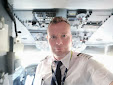
torstai 23. elokuuta 2018

Long time no write

Last time I wrote here I was still in ground school. Now I have been flying the line for two and a half months. Right now in a hotel room in Tallin - on a layover, which we have plenty.

I started my ground school in March and started flying in May. The simulator training was covered in two weeks and it was a very intense period. This was also because I was flying with another captain, so we had to learn the First Officer procedures as well. Talking about procedures, my company is using pretty much the Boeing procedures. Many new things and concepts came up, such as the system where we do a procedure by heart (e.g. After Takeoff Procedure) which after the corresponding checklist is completed by the Pilot Not Flying.

Perhaps the hardest thing for me was to learn that the go-around button was now replaced by the autothrottle disconnect switch. In all previous aircraft I've flown, the button under the thumb on the thrust lever was the go-around button, but not on the B737. Imagine the difficulty of learning to find the go-around button under your index finger and not your thumb! It meant that during my first go-arounds in the simulator I would disconnect the auto throttle every time, instead of setting the auto throttle and flight director in go-around mode.

Gotta go running now. Later....

maanantai 12. maaliskuuta 2018

1,5 years from biz jets to turboprops to Boeing

I decided to get back to blogging after a long while. The first and last time I wrote here before now was when I was still a biz jet captain flying VIP-charters around Europe, Middle-East, Africa and Asia.

A lot has happened since. I became a Safety and Compliance Monitoring Manager of the VIP-charter company. I was happy doing it for about a half a year and wanted to get out for twice as long. I missed flying because times were quite bad and there were not enough flights for me. The only thing I made fly were sheets of paper into the trash can.

So I took a job as a regional airline first officer with a fast tract to captain - with a starting salary of almost ⅓ of that of the previous job. But I got to fly - in about 14 months I flew more than 800 hours and did about 400 landings as pilot flying.

We flew mainly several short sectors per day which was fun. The people I worked with were fun too. The only thing that wasn't fun was the airplane. The ATR-72-500 really is a strange design with many weird and unique features. A demanding plane to fly and operate.  The prospect of flying that thing for maybe ten years without a chance of an upgrade just wasn't the ticket. They say that planes like the ATR do not need all the fancy automation as the big planes have, because they fly only short sectors. On the contrary! We flew 4-5 sectors per day, if all that repetition and workload is not the place for automation, then what is??

So when airBaltic in Latvia offered a 2-year contract flying the Boeing 737 as direct entry captain, typerating provided by the company, I didn't stop to think about it for too long.

So here I am, in Riga, Latvia, after the very first day as an airBaltic-employee. Today was a long one, company conversion training from nine to six, covering EFB, safety, security and other matters. The company seems to be taking care of things and us, which is nice. But they make us work hard.

The atmosphere is very relaxed and western. We are, after all, in an EU country and about 22 % of the staff are expats. Now I need a rest, another nine-to-six day tomorrow. Happy endings.